Making quality management more efficient
"During audits, we now carry only one laptop instead of multiple files and paper records."
AI powered software to easily manage requirements, specifications, risks, test cases with complete traceability
For taking a demo with our team.














Slide across to see what changes when everything lives in Matrix Req.
Engineering, quality and regulatory each keep their own documents. Change one requirement and you hunt by hand for every test and risk it touches.
One missed link between a design input, a risk and its test can become a nonconformity at review time and push your launch back.
Risk matrices live outside the development work, so they drift out of date and lose their link to the requirements that control them.
Every audit means rebuilding trace tables and chasing signatures across folders before the auditor arrives.
Requirements, specs, risks and tests live in one versioned system. Change one item and Matrix Req shows every downstream impact.
Set which traces are required. Matrix Req flags broken, missing or outdated links before a reviewer finds them.
ISO 14971 templates with your own scoring. Each risk links to the requirement that controls it and the test that proves it.
Generate trace tables and design documents from live data, with a full audit trail and 21 CFR Part 11 signatures.
What you get, and when
A typical rollout with one of our onboarding packages. Your pace depends on how much data you bring across.
Onboarding runs as two hour sessions with a Matrix Req specialist, planned around your team and the data you bring across.
Columns and sections map to Matrix fields, traces included. Some imports take one to two hours.
Create or link Jira, GitHub and GitLab issues from any item, set up during onboarding.
"The support has been second to none, with very fast responses and a comprehensive help function."
With a full migration package, most teams are fully moved off their old tool in under two months.
Required traces are enforced, so missing tests and unlinked risks surface in dashboards, not at the design review.
The built in AI assistant drafts requirements, risks and test cases in your own template.
"The biggest improvement Matrix Req has brought to our team is having one dependable source of truth for our development documentation."
Your design history file and trace tables generate from live data, in the same Word format you used before.
Compliance Checker turns a standard into a checklist and assesses your project item by item.
Records, signatures and change history come up on request, with the who, what, when and why of every edit.
"We can generate PDF documents in the same format as before in a highly automated way, improving our team's efficiency by an estimated 60%."
Core features
Press play on a feature to watch it in action, built on one demo project: a wearable ECG patch, from first requirement to signed document.
 2:36
Create a requirement, its specification and its test case, all traced, then see the whole chain in one view.
Watch the 2:36 video 3:26
The AI assistant inside Matrix Req drafts and refines requirements, specs and tests. Nothing lands until you approve it.
Watch the 3:26 video 1:35
Create or link issues right from a specification, and issue keys you type turn into links.
Watch the Jira video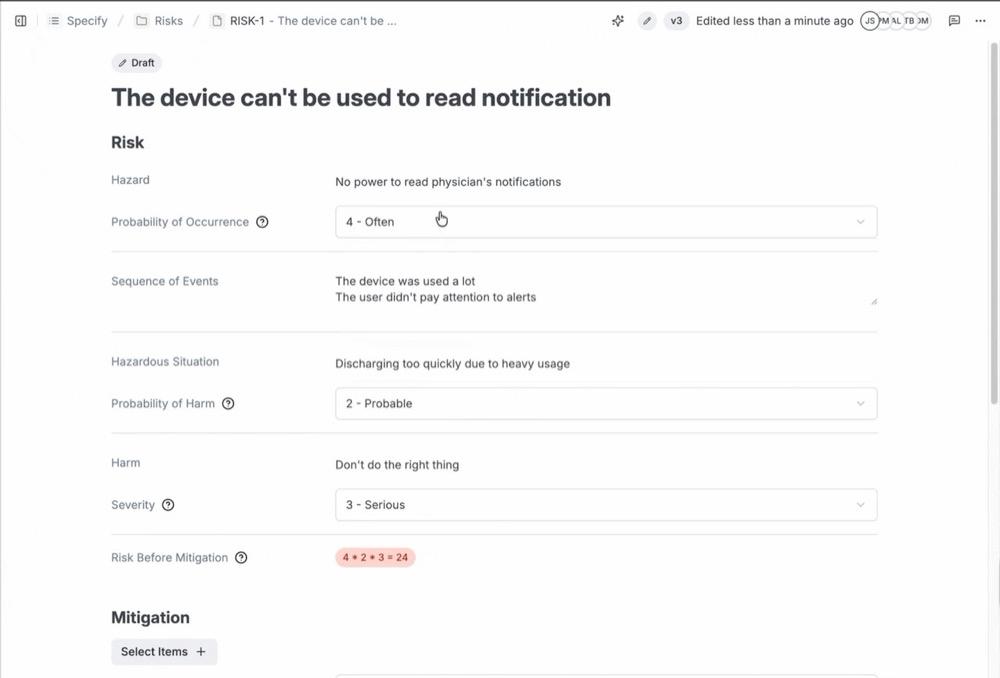
Assess risks, link each control to the design item that implements it, and see residual risk.
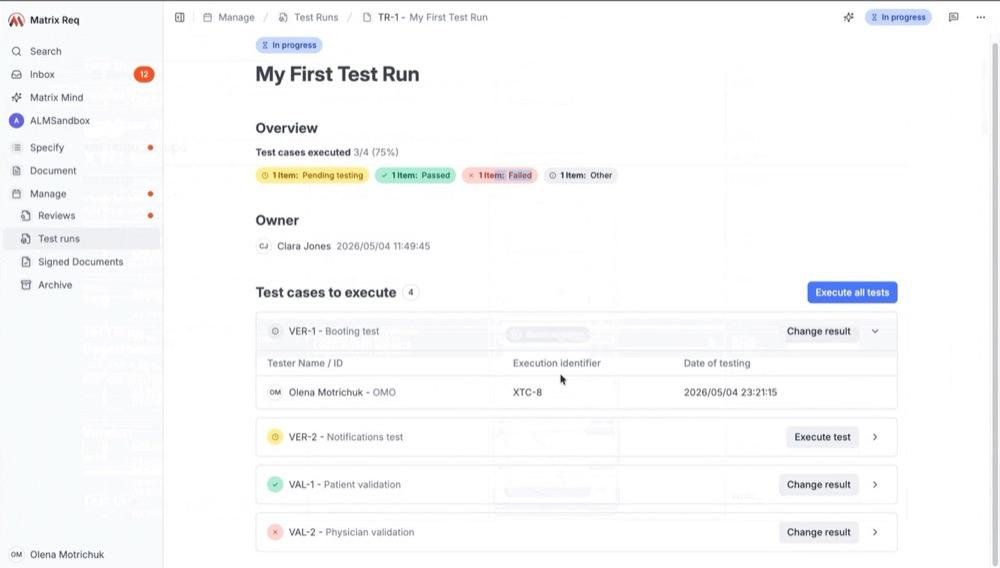
Plan, assign and run tests with a result for every step and live progress.
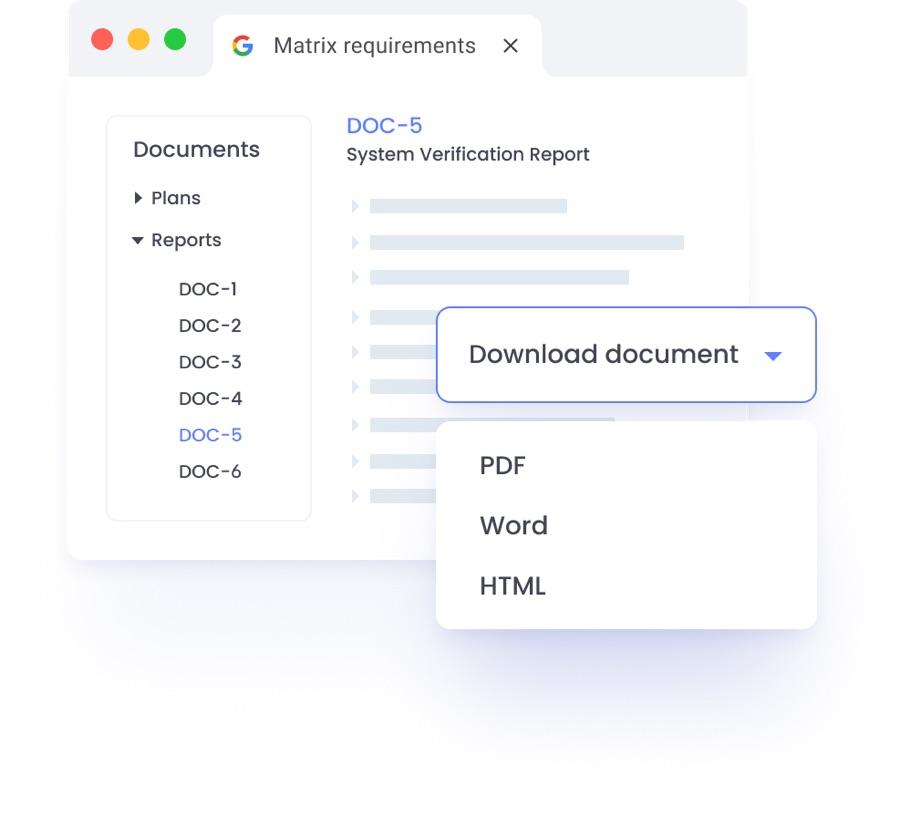
Build a requirements specification from live project data and preview the PDF before it goes out.
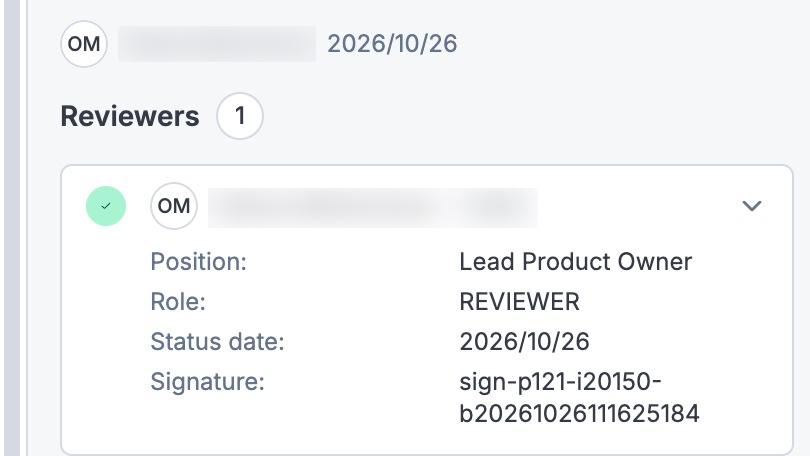
Route a document for review, sign it under 21 CFR Part 11 and keep a full audit trail.
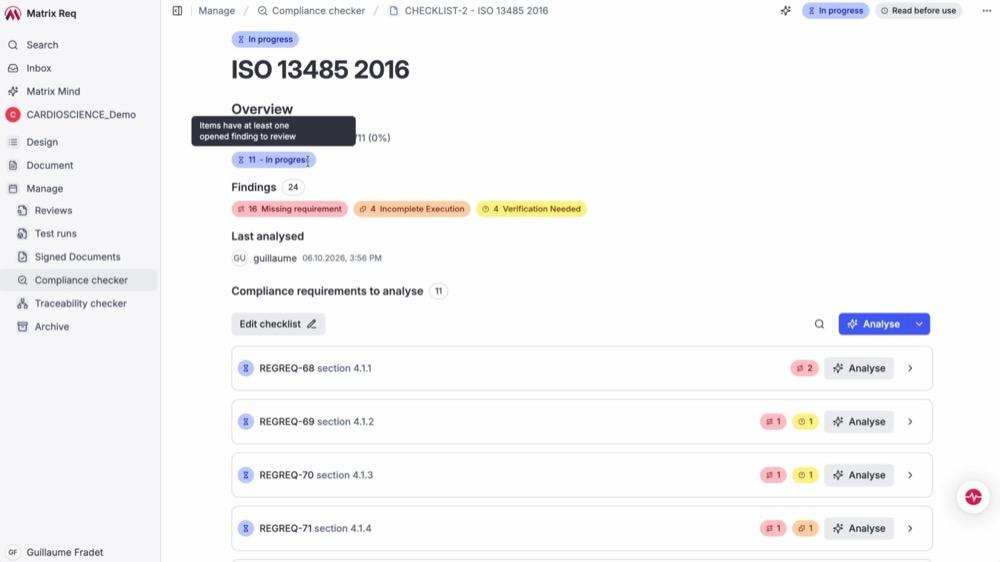
Turn a standard such as ISO 13485 or the MDR into a checklist and see in minutes where your documentation falls short.
"During audits, we now carry only one laptop instead of multiple files and paper records."
"It allows us to easily tailor custom fields and set up personalized traceability rules that fit our exact workflow."
"Through our tender process, Matrix came out as the most cost effective between the 3 options submitted."
"The documentation stays connected to the requirements, risks, and verification work that's already being maintained in Matrix Req."
"Automated document generation eliminated much of the manual Word and Excel work."
"We can see how a change affects downstream requirements, risk controls and verification activities without maintaining a separate spreadsheet."
Billed yearly. Book a demo and we’ll walk you through every feature.
For a device team getting design control under control.
Everything in Team Plus, plus a light QMS.
For larger organisations running several device programmes.
Teams that already know an ALM tool are often productive within a few days. Onboarding runs as two hour sessions with a specialist, and with a full migration package most teams are live in under two months.
Yes. Matrix Req maps your Excel columns or Word sections to its fields, so requirements, risks and tests come across with their traces intact. Our Premium package covers a full migration from another tool.
We provide a validation package for Matrix Req itself: plans, reports, test scripts and traceability matrices. Teams use it for 510(k), PMA and CE mark submissions, with 21 CFR Part 11 signatures and audit trails.
Yes. You can create or link Jira, GitHub and GitLab issues straight from a requirement or specification, and issue keys you type in any text turn into links.
Matrix Mind drafts requirements, risks and test cases in your template and helps you find anything in your documentation. Compliance Checker builds a checklist from any standard and assesses your project against it.
Yes. In 2025 the company rebranded to Matrix One and the software previously sold as Matrix Requirements became Matrix Req.
Every change in Matrix is automatically tracked with a revision history (who, what, when, why). You can lock items when design freezes using labels, and create "signed" snapshots of documents for regulatory submissions. Matrix generates red-line comparisons between any two versions, eliminating manual Word document comparisons. Perfect for design control and 21 CFR Part 11 compliance.
Absolutely. Matrix has a dedicated risk management module that supports multiple risk methodologies (FMEA, DFMEA, ISO 14971, hazard analysis). You can configure custom risk scoring matrices, link risks to requirements and mitigations, and generate compliant risk reports. We showed Medtronic how to handle complex multi-harm scenarios with automatic calculations.
No problem! You can add users anytime. The upgrade is immediate, with no downtime or data migration required. Most of our clients grow with us, so we are ready to scale for enterprise deployment across your acquisitions.
This is what our Compose module does. You create a "Base Library" with shared requirements (electrical safety, biocompatibility, EMC, etc.), and individual products "Include" from that library. When you update a shared requirement, it automatically propagates to all products using it. Perfect for companies with multiple product lines or acquisitions.
Over the years we have helped hundreds of medical device companies move away from paper based systems and legacy tools. Our customer success team has built data migration tools for whatever setup you have today, and our full migration package takes care of every step so that you can be up and running on Matrix Req in less than two months. Compare the onboarding and migration packages.
Our AI tools work in your own siloed environment. We have a Zero data retention agreement with our LLM provider. Your data is neither used to train our provider’s models or ours. Your data is safe and its confidentiality secured.
A 30 minute demo with a specialist who knows medical devices.